ConductCompliance for GMP
Watch GMP practice. Record every decision.
Cameras check the practices your procedures require, from gowning and glove changes to personnel flow and material handling. A reviewer decides each case, and your quality unit signs the reports FDA may ask to see.
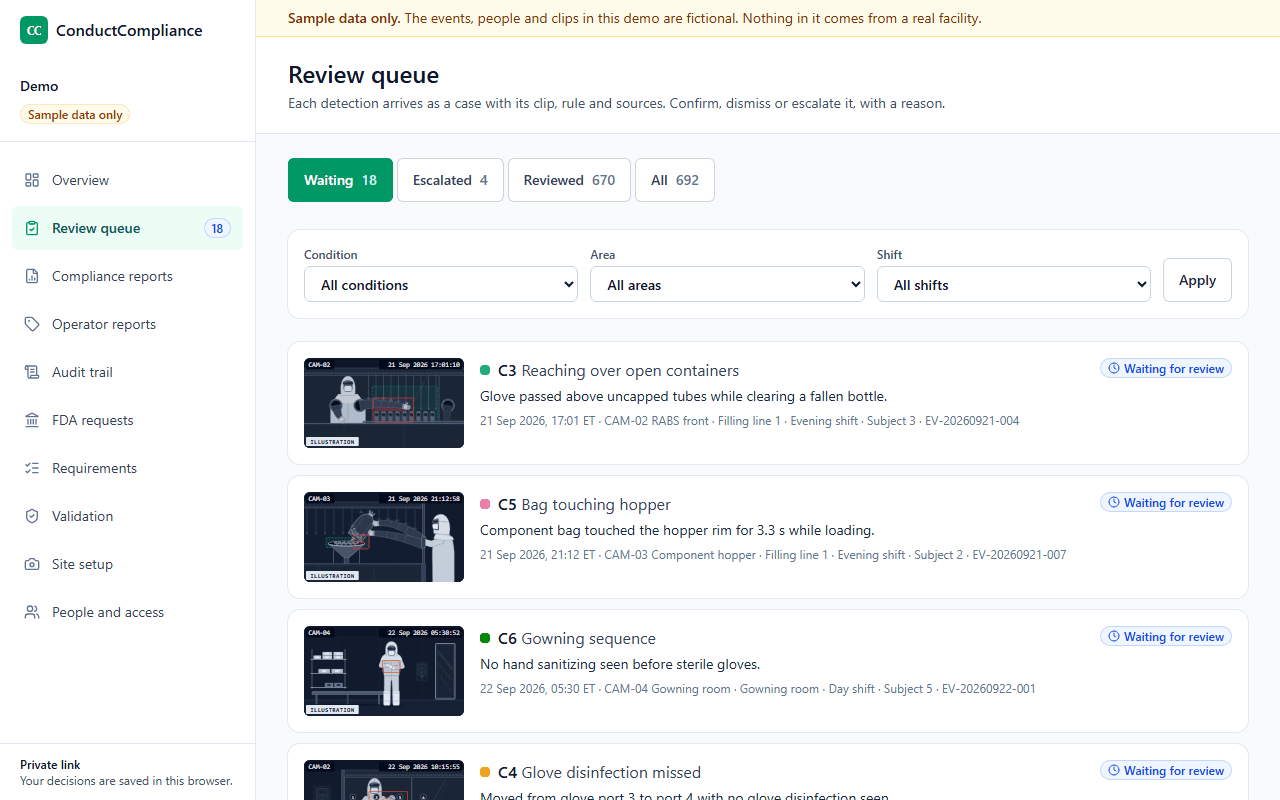
What it can watch
Written rules for the practices on your floor
Running in the demo
- Moving too fast in the filling room
- Components loaded incorrectly at the infeed
- Reaching over open containers
- Gloves not disinfected before sterile handling or between glove ports
- Component bag touching the hopper
- Gowning step missed or out of order
In the condition library
Interventions
- Grade A intervention not on the approved list, or not recorded
- Jam cleared without sterile tools
- Gloves not disinfected before a grade A intervention
Gloves
- No glove change when moving between filling lines
- Gloves changed or sanitized just before glove sampling
- No glove change after touching the floor
- No glove change after surface disinfection
- No glove change before unloading the autoclave
Gowning
- Goggles or face touched after gowning
- Skin exposed after gowning
- Hands not sanitized before gloving, or gloves donned out of order
- Disinfectant sprayed onto the garment
Disinfection
- Surface disinfection technique not followed
- More wipe strokes than the site limit
- Wipe pattern not unidirectional
Personnel flow
- Leaning on equipment
- More people in the gowning room than its limit
- Door opened with gloved hands
- Two people through one door opening
More requirements a camera can check
21 CFR 211 and FDA guidance
- Number of people inside the aseptic processing room at one time
- A person entering a limited-access area
- How often people enter and leave the aseptic processing room and its critical area
- How much operators move next to the critical area
- Component boxes or bags stored on the floor, or without spacing
EU GMP Annex 1
- Both airlock doors open at the same time
- Grade A and B gowning worn while working in a grade C area
- Inspector breaks and time at the station during visual inspection
- A watch, jewelry or a phone in the cleanroom
- A garment inspected before and after gowning
- Items inspected on removal from the autoclave
- People leaving grade B through the change room meant for entry
- Hands touching vials at the capping station
How it works
From a camera view to a signed record
Detect
A detector on your monitoring computer checks each camera view against a written rule and opens a case with a short clip.
Read more about detectReview
A trained reviewer confirms, dismisses or escalates the case with a reason. Only a quality lead closes an escalation.
Read more about reviewSign
Reports for any week or month become controlled records: a quality review, then approval by a second person.
Read more about signAnswer FDA
Build a records package, show records read-only in an inspection, draft a 483 response and count the Field Alert Report clock.
Read more about answer fda
What your team hands over
Documents your quality unit can sign and send
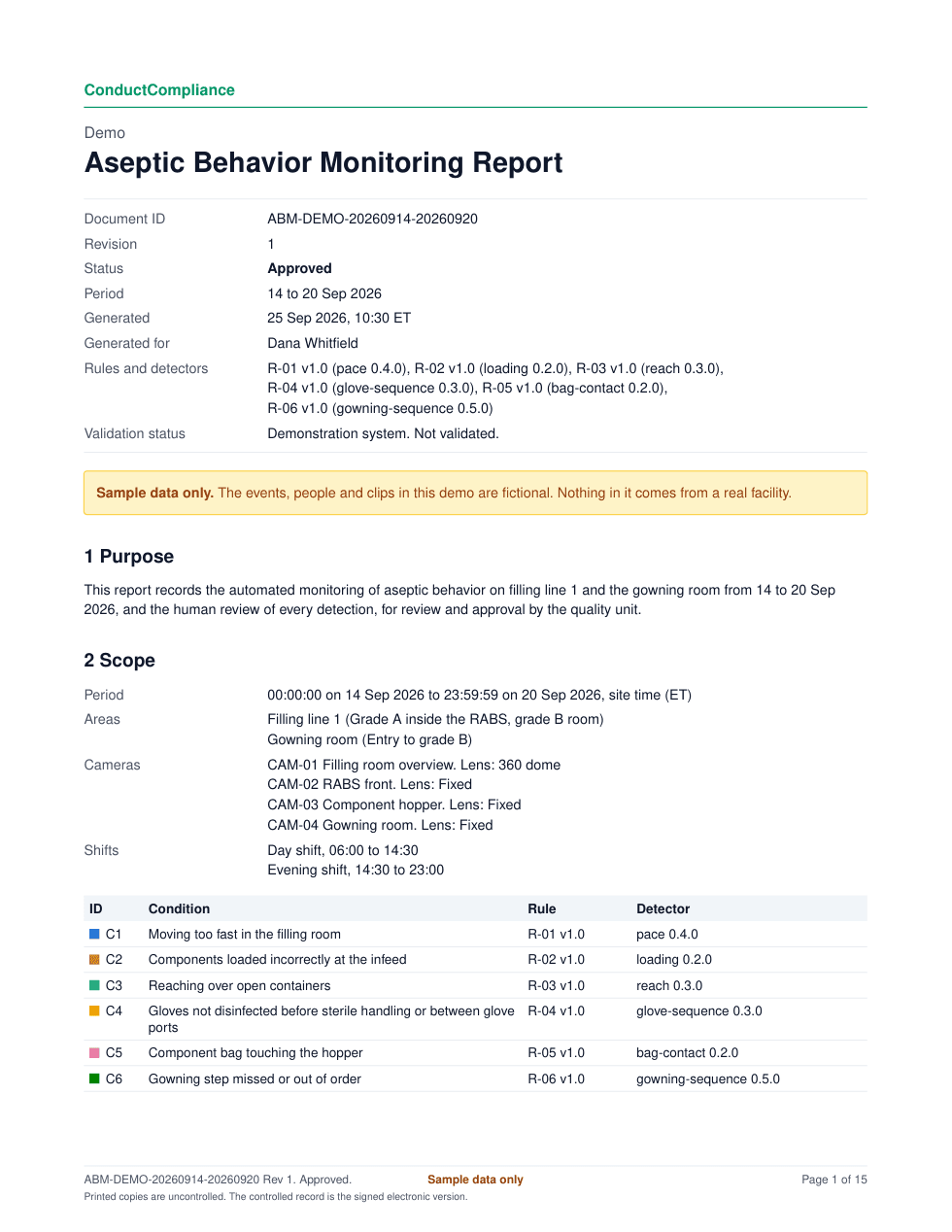
Aseptic Behavior Monitoring Report
PDFXLSXCSVEvery detection and decision for a week, month or date range, with trends, escalations, the audit trail and signatures.
Event record
PDFOne case: what the camera saw, the rule and its sources, and every decision, ready to attach to a deviation.
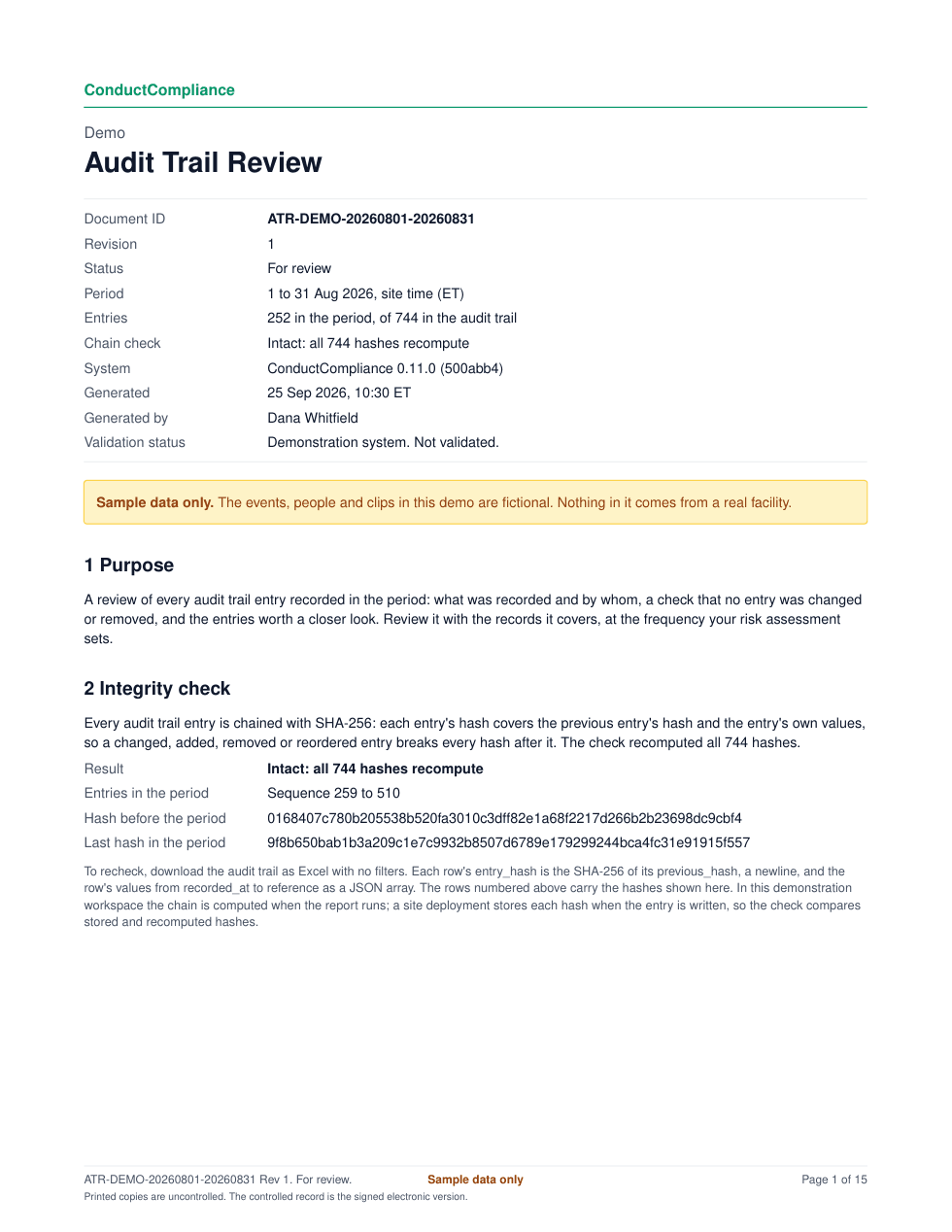
Audit trail and audit trail review
PDFXLSXCSVEvery decision with a SHA-256 hash chain, and a review report for any period with an integrity check and exceptions.
Every signature with its meaning, signer, time, revision and data fingerprint, and whether it is current or superseded.
Who can get in, each person's role, and what each role may do, printed from the table the software enforces.
An index keyed to FDA's items, the records for the period and a SHA-256 checksum for every file.
Form FDA 483 response kit
DOCXPDFAn editable response letter and signed monitoring evidence for each observation linked to a monitored condition.
Validation package
ZIPDOCXXLSXValidation plan, requirements, risk assessment, system description, IQ, OQ and PQ scripts and templates for the rest.
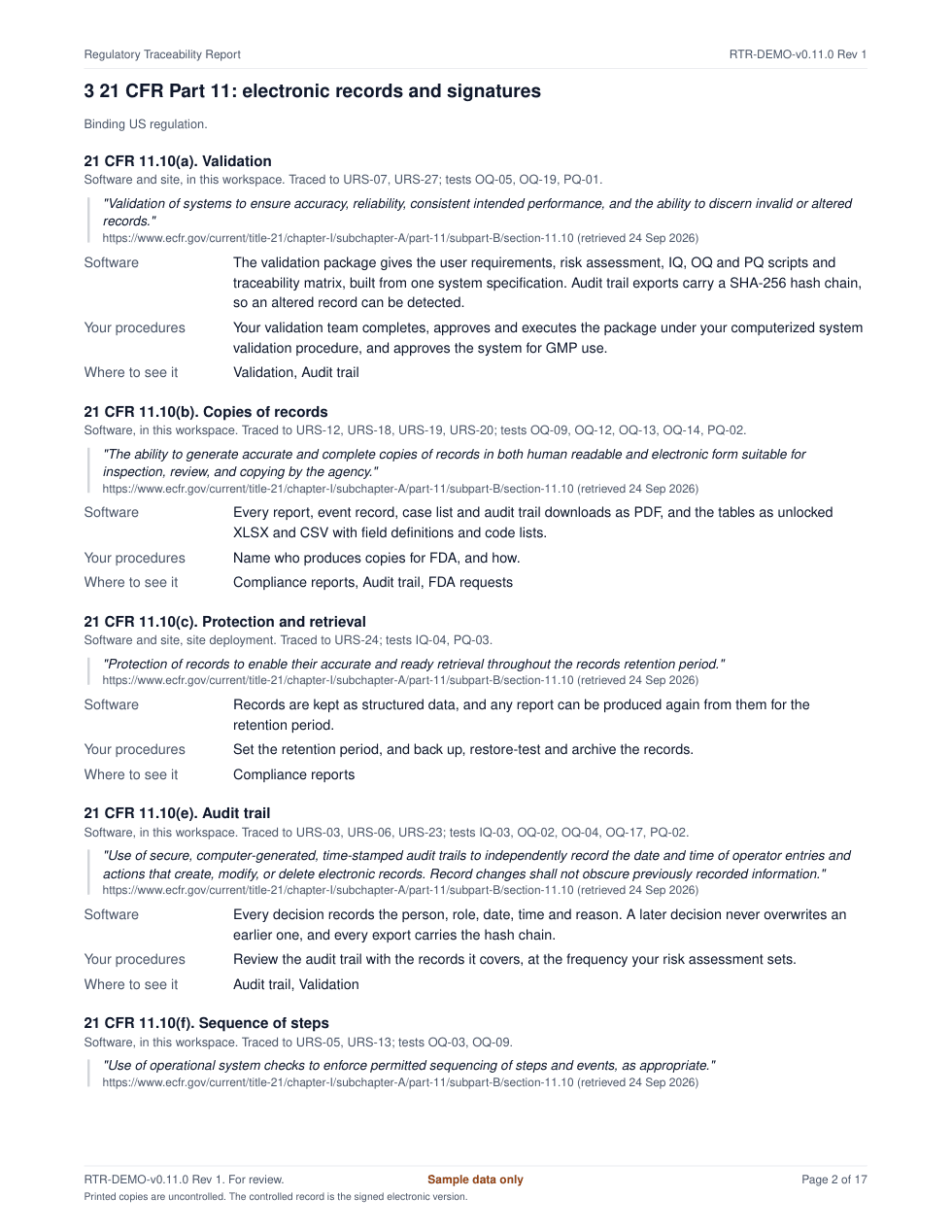
Every Part 11, Part 211 and Annex 11 requirement, quoted, with what the software and your procedures each do.
Every release with its changes, the functions it touched and which tests to repeat before use.
Built on the regulations
The passages behind each rule, quoted word for word
“Aseptic operations (including APS) should be observed on a regular basis by personnel with specific expertise in aseptic processing to verify the correct performance of operations including operator behaviour in the cleanroom and address inappropriate practices if detected.”
“Supervisory personnel should routinely evaluate each operator’s conformance to written procedures during actual operations. Similarly, the quality control unit should provide regular oversight of adherence to established, written procedures and aseptic technique during manufacturing operations.”
“Use of secure, computer-generated, time-stamped audit trails to independently record the date and time of operator entries and actions that create, modify, or delete electronic records. Record changes shall not obscure previously recorded information.”
“Written production and process control procedures shall be followed in the execution of the various production and process control functions and shall be documented at the time of performance. Any deviation from the written procedures shall be recorded and justified.”
- requirements mapped to what the software and your team do
- 60
- 21 CFR Part 11 clauses, each quoted
- 17
- EU GMP Annex 11 clauses, each quoted
- 18
- monitored behaviors, each with its sources
- 6
Read them clause by clause: 21 CFR Part 11 and EU GMP Annex 11.
Free for any GMP team
Tools and references you can use today
- ToolsFDA deadline calculatorCount the days for a 483 response, a Field Alert Report or a records request.Read more
- Regulations21 CFR Part 11Each Part 11 requirement quoted from the eCFR, with who meets it and how.Read more
- RegulationsEU GMP Annex 11Each Annex 11 clause quoted from the 2011 text, with who meets it and how.Read more
Validation
Validation starts from drafts
- system functions, each rated for risk
- 14
- user requirements, each traced to its source
- 29
- IQ, OQ and PQ test scripts
- 29
- Word drafts in the package
- 10
Where it runs
Footage stays on your network
At your site
Cameras, the monitoring computer that runs the detectors, and the clips and frames they record. Cases cite each clip by ID, so the footage never has to leave your network.
In the workspace
Cases, decisions, signatures, reports and exports. Where the workspace runs, and how people sign in, is set up with your IT team.
Questions
Common questions
- Is it only for aseptic processing?
- No. The first detectors cover aseptic processing, where regulators ask most directly for observation of how people work. The same review, audit trail, signatures, reports and FDA tools apply to every condition you add, such as gowning, glove changes, disinfection, personnel flow and material handling. Each condition is added with its own rule, cameras, limit and detector.
- Is the software Part 11 compliant?
- Part 11 applies to the company that keeps the records, so compliance comes from validated systems plus your procedures and training. The software gives you the controls Part 11 describes, such as audit trails, signature details and authority checks, and the documents your team needs to validate them. Your quality unit decides.
- Does video leave our site?
- Clips and frames stay on your network. Each case cites its clip by ID, and your team can show any clip on screen or provide a copy when asked.
- Who decides whether an event is a violation?
- A trained reviewer, every time. The detector opens a case; a person confirms, dismisses or escalates it with a reason, and a quality lead closes each escalation with an outcome.
- Which regulations do the rules cite?
- Each rule cites its site procedure and the passages behind it from EU GMP Annex 1, FDA's guidance on sterile drugs produced by aseptic processing and 21 CFR Part 211, quoted word for word with links to the official texts.
- How do we validate it?
- Start from the validation package: 10 Word drafts, a traceability matrix and a regulatory report. Your team reviews and approves them, runs the IQ, OQ and PQ scripts, and signs the summary report before GMP use.
- Can we see it before we talk about a pilot?
- Yes. Request a walkthrough and we will show the workspace with sample data, including the documents it produces.
See it with sample data
We show the review queue, a signed monitoring report, the audit trail review and the validation package, then answer your team's questions.